01
A research project on AI, politics and society

Decoding moral and sociopolitical biases in AI

Understanding how political and moral values are represented inside large language models, how they can be manipulated, and how they shape scientific and public information.

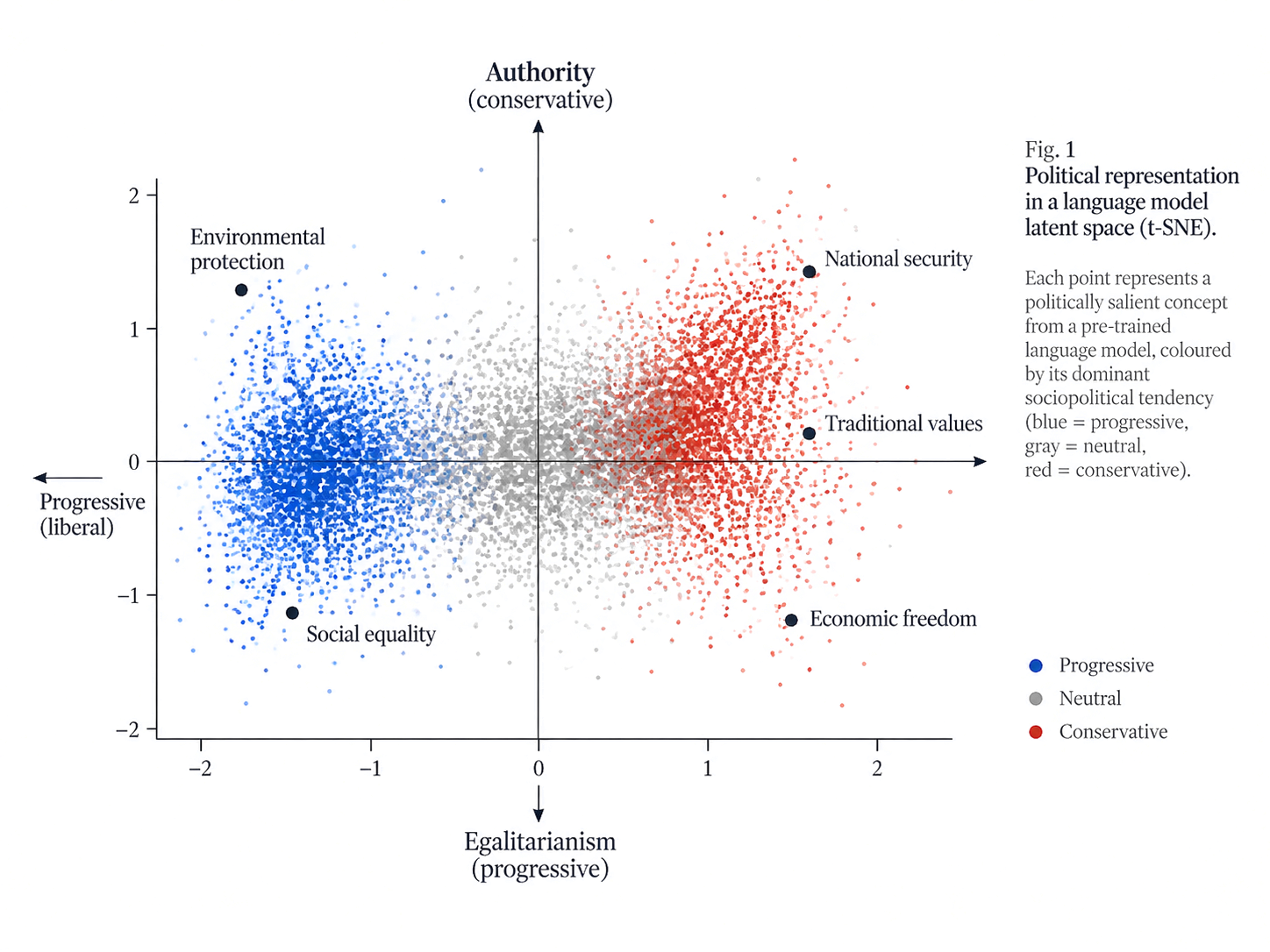
Fig. 1 — Political representation in a language model latent space (t-SNE): concepts coloured progressive, neutral or conservative

Illustrative figure — not yet a project result.

02

AI systems are not politically empty.

Large language models absorb ideological and cultural regularities from their training data. These representations can affect how models classify, generate and recommend content — with real consequences for scientific knowledge and public perception.

01

Where are political values represented inside language models?

02

Can those representations be manipulated?

03

Do they affect what models classify, recommend or generate?

Three key research questions
03

Our research programme

We combine representation analysis, model intervention and behavioural evaluation to understand the nature and consequences of sociopolitical biases in AI.

01

MAP

Political values inside LLMs

Linear probing · Representation analysis
02

INTERVENE

Change internal representations

Activation steering
03

TEST

Observe behavioural consequences

Classification · Polarization · Incivility
04

AUDIT

Question the gold standard

Human–LLM auditing
05

UNDERSTAND

Political and societal consequences

Public opinion · AI-mediated information
04
Models methods evidence

Political values across model layers

We use linear probing to detect political and moral value representations in model activations across layers, and test how they can be modified through activation steering.
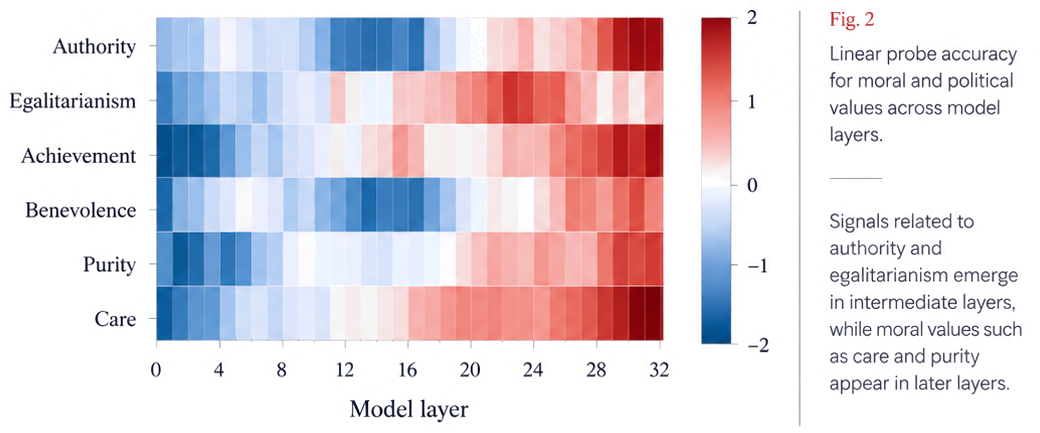
Fig. 2 — Heatmap of linear probe signal for authority, egalitarianism, achievement, benevolence, purity and care across model layers 0 to 32

Illustrative figure — pattern the project will test, not yet a result.

05

Selected outputs

All outputs →
  • Paper · 2025Only a Little to the Left: A Theory-grounded Measure of Political Bias in LLMsACL →
  • Paper · 2025Extracting Affect Aggregates from Social Media Data with Temporal Adapters for LLMsICWSM →
  • Preprint · 2025LLMs replicate and predict human cooperation across experiments in game theoryarXiv →
06

People

DEMOS-AI brings together researchers in computational social science, political psychology and natural language processing.

Meet the team →

Max Pellert

Max Pellert

Principal Investigator
Paula Szewach

Paula Szewach

Co-Principal Investigator

Alberto Martínez Serra

Alberto Martínez Serra

Postdoctoral researcher

Alejandro De La Fuente-Cuesta

Alejandro De La Fuente-Cuesta

Research team


Martín García Ortiz

Martín García Ortiz

Research team
Interior of MareNostrum 5 at the Barcelona Supercomputing Center
07

Built at Barcelona Supercomputing Center

DEMOS-AI uses open-weight language models running on BSC infrastructure, allowing direct access to model activations and reproducible experimentation without relying on commercial APIs.

About our infrastructure →